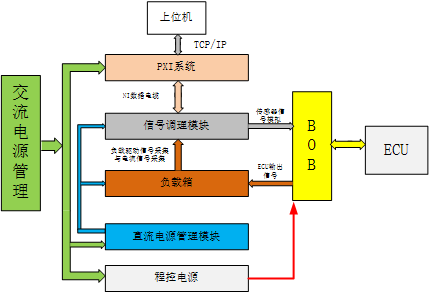
The Fuel Cell Controller (FCU) is the core control unit of a fuel cell system, responsible for coordinating the hydrogen circuit, air circuit, water and thermal management system, as well as voltage/current monitoring, while implementing power output control and fault diagnosis. To efficiently and safely validate the various functions of the FCU, a dedicated Hardware-in-the-Loop (HiL) test system has been developed.
This HiL system is built on a real‑time simulation platform and is capable of high‑fidelity emulation of key components and dynamic characteristics of the fuel cell engine, including: the stack (polarization curve, membrane water content, temperature characteristics), the hydrogen supply subsystem (injection valves, recirculation pump, purge valve), the air supply subsystem (air compressor, back pressure valve, flow meter), the water and thermal management subsystem (water pump, thermostat, radiator, PTC heater), and cell voltage monitoring (CVM) signals. By simulating real operating conditions, the system achieves full‑functional coverage testing of the FCU.
The main verification contents of the FCU HiL test bench include:
-
Control Logic and Strategy Validation:Test whether the FCU’s hydrogen pressure control, air compressor speed regulation, stack humidity management, and coolant temperature control logic are correct during start/stop, idle, load change, and emergency shutdown. Especially for cold start conditions, the heating and preheating strategies under low‑temperature environments can be simulated to evaluate the FCU’s start‑up success rate and response time.
-
Fault Injection and Diagnostics Testing:Using signal conditioning and fault injection boards, various sensor faults (e.g., hydrogen concentration sensor failure, temperature sensor drift, pressure sensor stuck), actuator faults (e.g., recirculation pump stall, air compressor overcurrent, injection valve stuck), and internal stack faults (e.g., low cell voltage, polarity reversal) can be simulated. This verifies the FCU’s fault detection, fault reporting, and safety protection mechanisms (e.g., emergency shutdown, nitrogen purging).
-
Bus Communication and System Integration Testing:The FCU communicates with the Vehicle Control Unit (VCU), Battery Management System (BMS), and Thermal Management Controller (TMS) via CAN/CANFD or Ethernet. The HiL system can simulate these controller nodes to verify the FCU’s message parsing, signal mapping, network management, and diagnostic protocol (UDS) implementation.
-
Real‑Time Performance Evaluation:Measure the complete response delay of the FCU from sudden sensor signal changes to actuator outputs, and evaluate the stability of output voltage/current under load change conditions, ensuring the controller meets real‑time requirements.
The HiL test bench uses real‑time targets from NI, dSPACE, or similar platforms, equipped with customized signal conditioning modules, high‑voltage simulation power supplies, and electronic load simulators. Test automation is based on platforms such as Teststand or ECU‑TEST, supporting regression testing, extreme‑condition traversal, and rapid calibration parameter validation. By introducing the FCU HiL test system, development teams can expose and resolve control software defects early in the laboratory environment, significantly reduce vehicle debugging risks and hydrogen consumption costs, and accelerate the development and certification cycle of the fuel cell controller.