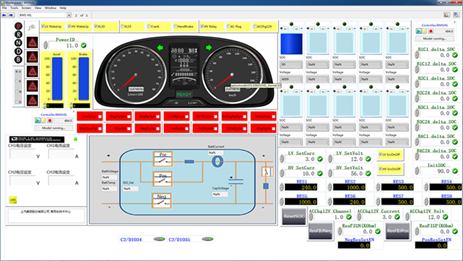
The BMS Hardware-in-the-Loop (HIL) test bench is specifically designed for comprehensive testing of the Battery Management System (BMS) controller. The BMS is a core component in new energy vehicles and energy storage systems, and its performance directly impacts battery pack safety, lifespan, and overall vehicle reliability. Typically, a BMS possesses six key functions: sampling (voltage, current, temperature), alarming (overvoltage, undervoltage, overtemperature, overcurrent, etc.), estimation (SOC, SOH, SOP, etc.), communication (CAN, LIN, daisy chain, etc.), control (relay welding detection and control, charging control, precharge management, etc.), and balancing (passive or active balancing).
For BMS with a hierarchical architecture, the testing of the above functions can be carried out at three levels depending on the actual system configuration:
-
Slave control units (e.g., CMC, CMU, LECU): Focus on cell voltage/temperature sampling, balancing control, fault reporting, and daisy-chain communication testing.
-
Master control unit (e.g., BMU, BMC, CECU): Focus on total voltage/current sampling, SOC/SOH estimation, relay control logic, charging handshake, system alarming, and communication with the vehicle controller.
-
Battery system level: Verify pack-level thermal propagation protection, high-voltage safety, insulation monitoring, and the coordinated response between the BMS and actuators such as battery modules, relays, and fuses.
The HIL test bench is built on an NI platform real-time system simulator, capable of high-fidelity emulation of battery cells, modules, and high-voltage system electrical characteristics. It is equipped with a single‑phase or three‑phase five‑wire power supply and protection system to ensure a safe and stable test environment. Furthermore, customized signal conditioning modules enable accurate simulation and acquisition of sensor signals (e.g., thermistors, shunts, Hall sensors) and support fault injection (such as open circuits, short circuits, and signal offset).
On the software side, the bench runs custom test management software based on Veristand for model configuration, real‑time monitoring, and test sequence orchestration. It also integrates automated test software based on Teststand for batch execution of test cases, parameter iteration, and automatic report generation. With this HIL platform, users can simulate various real‑world operating conditions (including low temperature, high temperature, charging, high‑current discharging, relay welding faults, etc.) in a lab environment. It enables comprehensive and automated validation of BMS functional integrity, estimation accuracy, response time, and robustness, thereby significantly shortening development cycles, reducing real‑vehicle testing risks, and improving product quality.