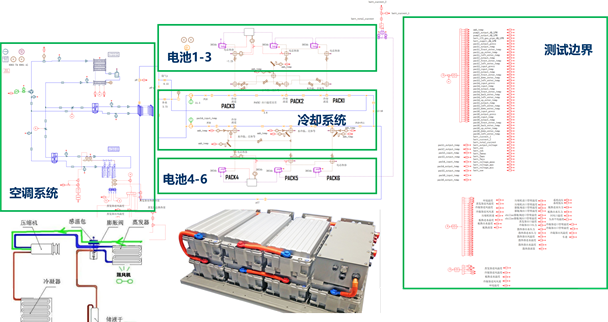
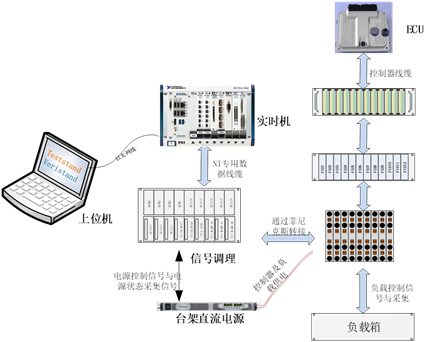
The thermal management Hardware-in-the-Loop (HiL) test system is a high-fidelity real-time simulation test platform developed for the thermal management controller (TMS) of new energy vehicles. Its primary task is to virtualize and model the real thermal management system structure and the controller, and to achieve comprehensive verification of controller functions in a real-time environment.
As shown in the figure, a real thermal management system typically includes complex heating circuits, cooling circuits, motor cooling circuits, the air conditioning system, and battery packs (e.g., Battery 1–3, Battery 4–6), with temperature regulation achieved through actuators such as water pumps and three-way electronic valves. To meet the real-time requirements and computational resource constraints of HiL testing, the original simulation model must undergo scientific simplification. This process is not a simple deletion of modules, but rather a systematic procedure based on activity analysis, state statistics, modal projection, and model processing.
Specifically:
-
Activity Analysis: Calculate the contribution rate of each module to the system response using energy-based statistical methods, and remove redundant modules to save simulation CPU resources.
-
State Statistics: Identify key time points in the time-varying system under specific operating conditions that excite high-frequency dynamic components.
-
Modal Projection: Perform frequency analysis on the identified key time points to locate the specific state variables responsible for high-frequency responses.
-
Model Processing: Adjust the model in real time (e.g., replace sub-models) based on modal analysis results and experimental system characteristics, ensuring both simulation accuracy and real-time performance.
After the above simplification and optimization, the thermal management system model is deployed into a real-time simulator and connected to the controller under test (e.g., an integrated thermal management module controller) via hardware interfaces, forming a complete HiL test system. This system can simulate temperature variations, sensor signals, and actuator responses under real vehicle operating conditions. It supports fault injection, extreme-condition testing, and control strategy validation, greatly improving development efficiency and system reliability.